Email: hp@hpfluid.com Tel: 0086-18019736555
Email: hp@hpfluid.com Tel: 0086-18019736555
Q367F Fixed Worm Gear Buried Welded Ball Valve
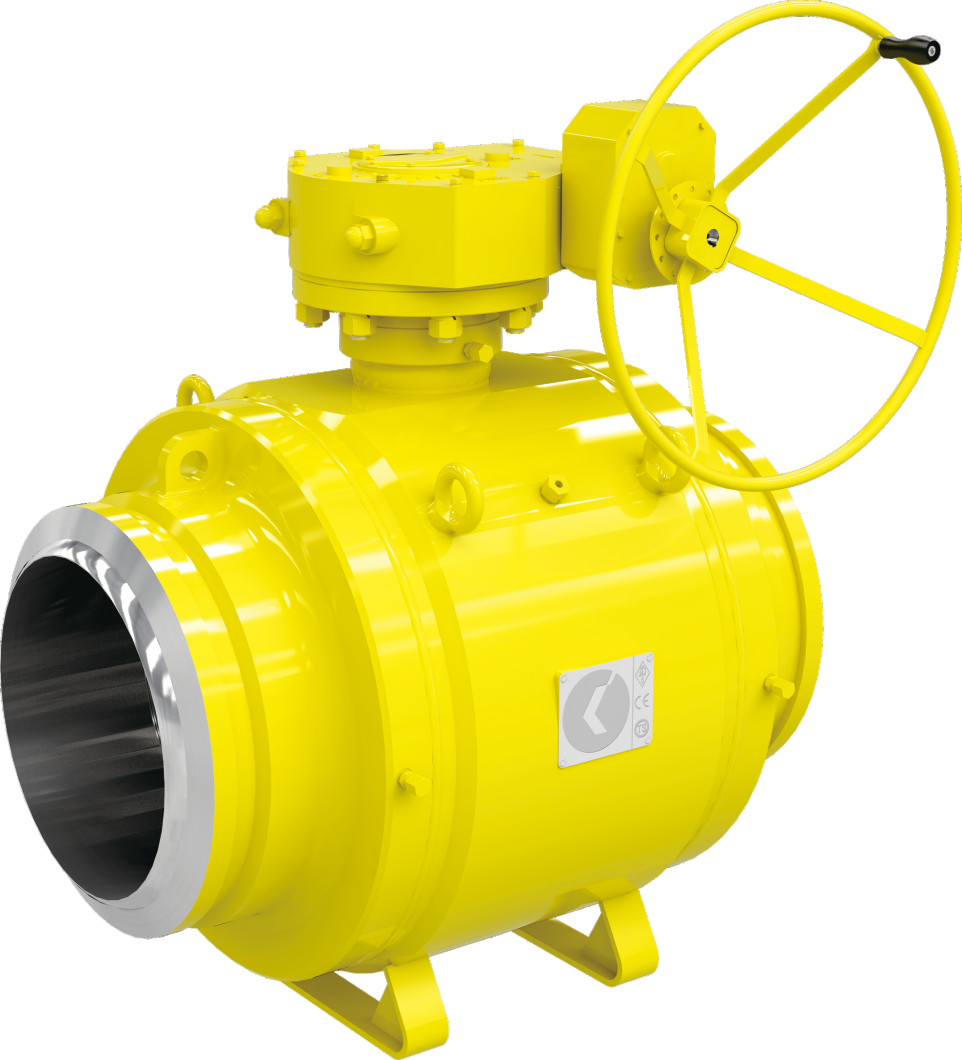
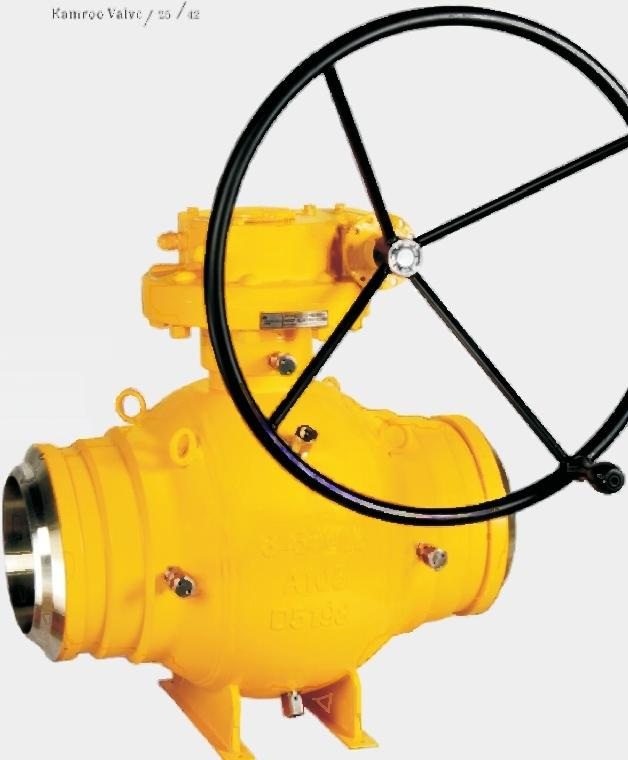
The fully welded ball valve is designed and manufactured in accordance with GB, DIN, API, ASME and other relevant standards. It adopts an advanced forged steel spherical body and a fully welded body structure with a single longitudinal weld seam. Equipped with a PMSS seat, the valve effectively guarantees sealing performance and is widely used in key applications such as long-distance natural gas pipelines, urban loop networks, pressure regulating stations and oil product transmission and distribution systems.
Design and Manufacturing Features
The fully welded ball valve is designed and manufactured in accordance with API 6D. Testing and inspection comply with API 6D, and fire-safe testing complies with API 607 and BS 6755.
Two body configurations are available:
Cylindrical body fully welded ball valve
Spherical body fully welded ball valve
Seating System:
Primary seal: metal seal
Secondary seal: non-metallic seal
The fully welded ball valve is designed and manufactured in accordance with GB, DIN, API, ASME and other relevant standards. It adopts an advanced forged steel spherical body and a fully welded body structure with a single longitudinal weld seam. Equipped with a PMSS seat, the valve effectively guarantees sealing performance and is widely used in key applications such as long-distance natural gas pipelines, urban loop networks, pressure regulating stations and oil product transmission and distribution systems.
The fully welded ball valve is designed and manufactured in accordance with API 6D. Testing and inspection comply with API 6D, and fire-safe testing complies with API 607 and BS 6755.
Two body configurations are available:
Cylindrical body fully welded ball valve
Spherical body fully welded ball valve
Seating System:
Primary seal: metal seal
Secondary seal: non-metallic seal
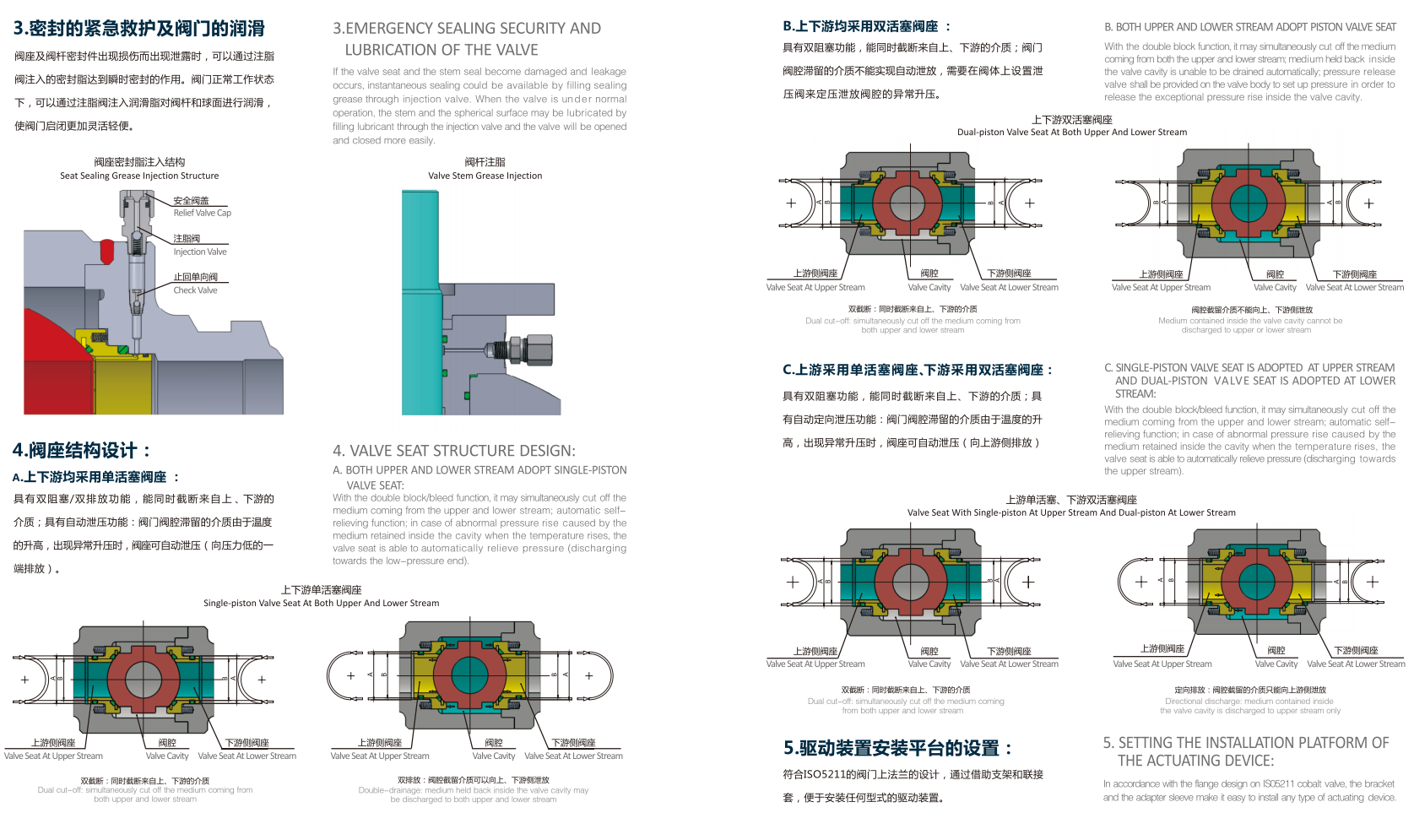
For nominal pressure Class 600 (10.0 MPa) and below, the secondary non-metallic seal uses Viton‑AED.For pressures above Class 600 (10.0 MPa), sealing materials include Devlon, PEEK and all‑metal seals.
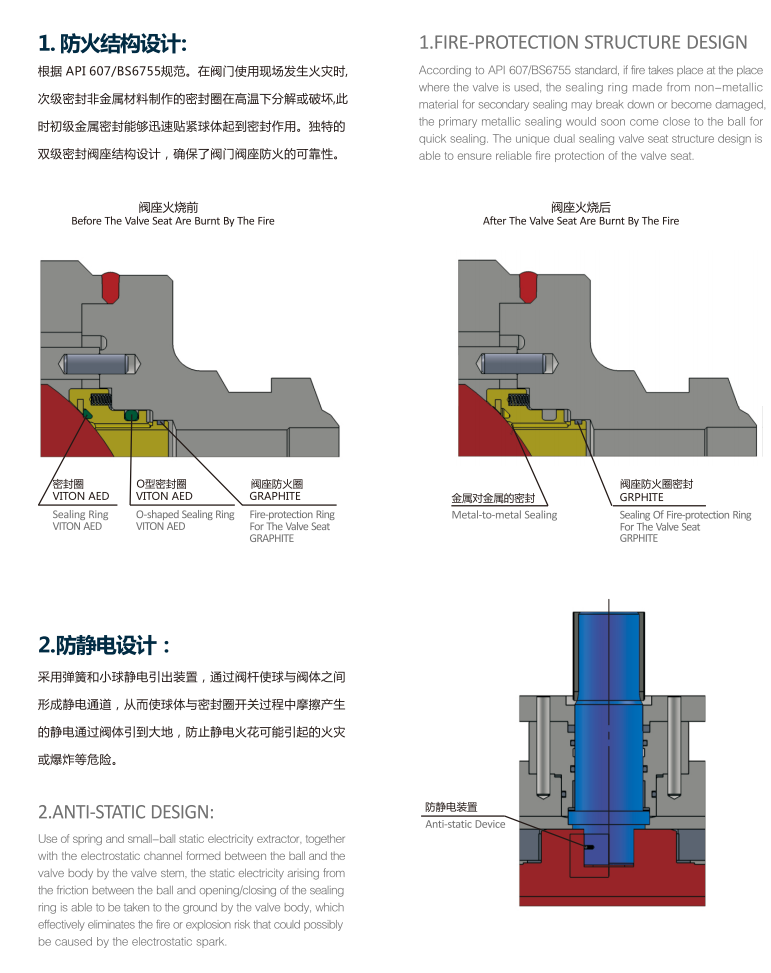
In accordance with API 607 / BS 6755, in the event of a fire, the non‑metallic secondary seal will decompose or fail at high temperatures. The primary metal seal will immediately contact the ball to provide tight shut‑off. The unique dual‑seal seat structure ensures reliable fire‑safe performance.
An anti‑static device consisting of springs and contact balls provides a conductive path between the ball and the body through the stem. Static electricity generated by friction during operation is discharged to the ground, preventing fire or explosion hazards caused by static sparks.
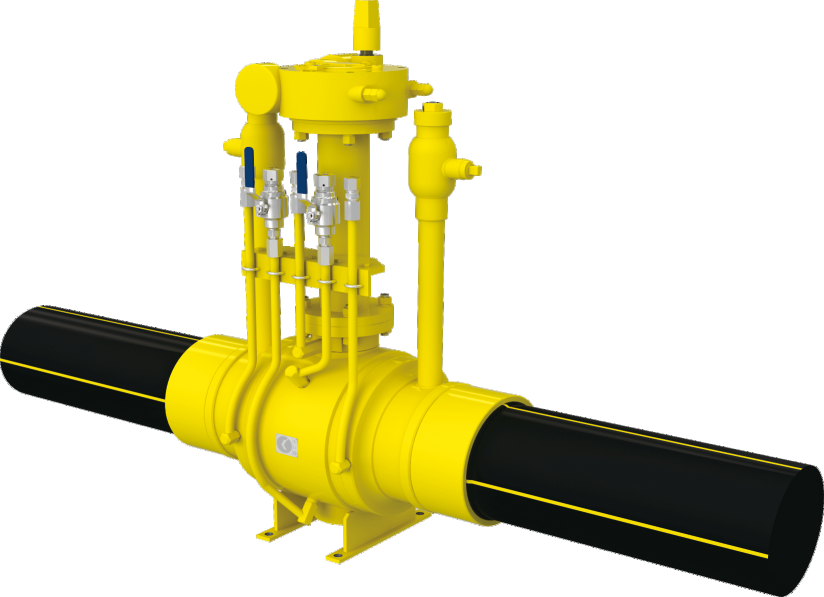
If leakage occurs due to damage to the seat or stem seals, emergency sealant can be injected through the sealant injection valve to achieve instant sealing. During normal operation, lubricant can be injected to lubricate the stem and ball surface, ensuring smooth and low‑torque operation.
Provides Double Block & Bleed function, isolating media from both directions.
Automatic pressure relief: overpressure in the body cavity caused by thermal expansion is automatically relieved to the low‑pressure side.
Provides Double Block function, isolating media from both directions.
No automatic cavity relief; a pressure relief valve must be installed to discharge abnormal cavity pressure.
Provides Double Block function, isolating media from both directions.
Directed automatic pressure relief: overpressure in the body cavity is automatically relieved to the upstream side.
The top flange is designed in accordance with ISO 5211, allowing easy mounting of any type of actuator using brackets and couplings.
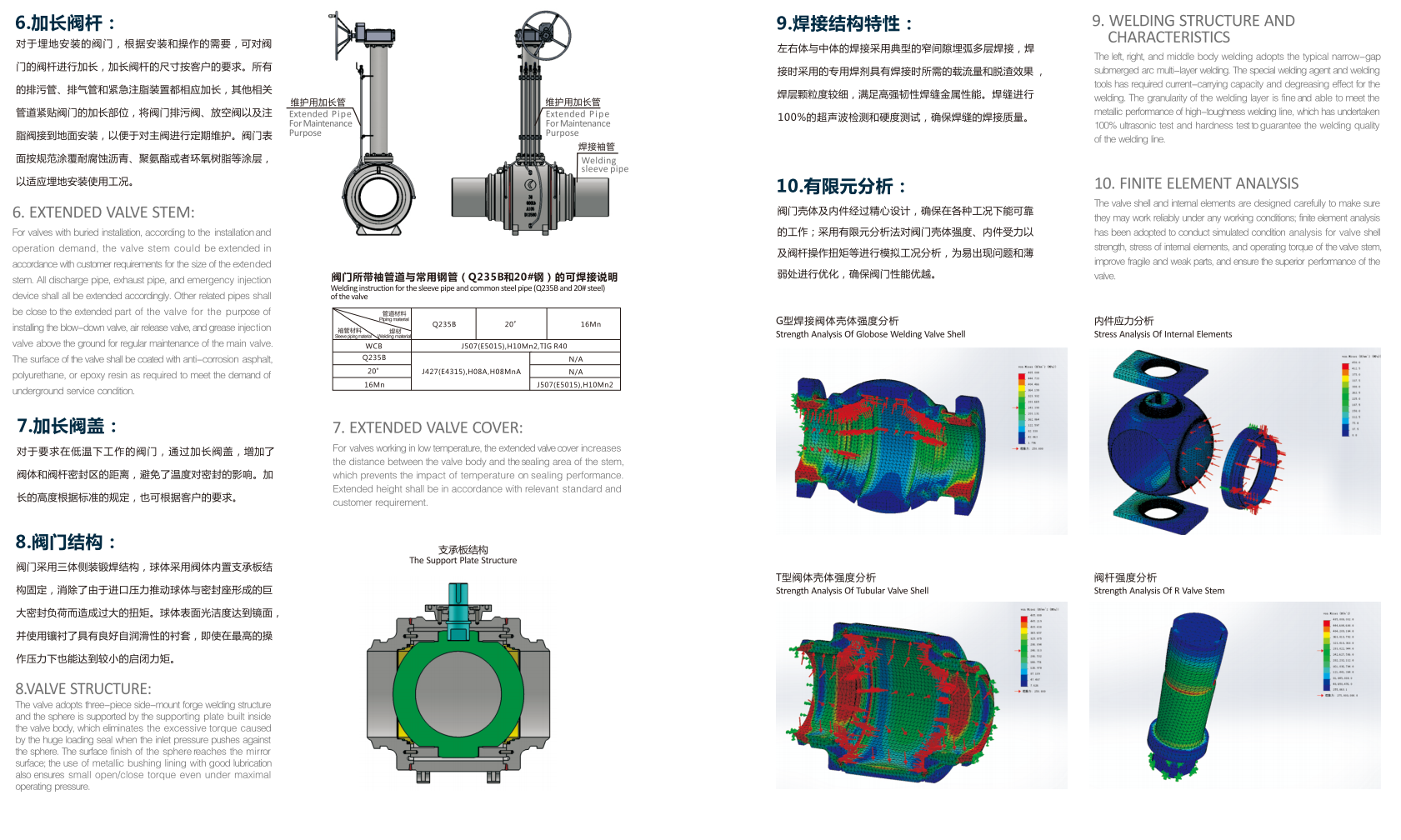
For buried installation, the stem can be extended according to installation and operation requirements (custom lengths available). All drain lines, vent lines and emergency sealant lines are extended accordingly. Related pipes are arranged close to the extended part, with drain valves, vent valves and sealant injection valves mounted at ground level for convenient routine maintenance.The valve surface is coated with corrosion‑resistant materials such as asphalt, polyurethane or epoxy to suit buried service conditions.
For low‑temperature applications, an extended bonnet increases the distance between the body and the stem seal area, protecting seals from extreme temperatures. The length complies with relevant standards or customer specifications.
The valve features a three‑piece side‑entry forged and welded structure, which eliminates excessive operating torque caused by high sealing loads between the ball and seat under inlet pressure.The ball has a mirror‑finish surface and is fitted with self‑lubricating bushings, ensuring very low operating torque even at maximum operating pressure.
The left, right and center sections are joined by typical narrow‑gap multi‑layer submerged arc welding. Special welding flux ensures stable current transfer and good slag removal. The weld layer has a fine microstructure to meet the requirements of high strength and high toughness.All welds are subjected to 100% ultrasonic testing (UT) and hardness testing to ensure welding quality.
The valve body and internal components are elaborately designed to ensure reliable performance under various working conditions.Finite element analysis is used to simulate body strength, internal part force and stem operating torque. Potential weak points are optimized to ensure superior valve performance.
Contact: LISA.YU
Phone: 0086-18019736555
Tel: 0086-18019736555
Email: hp@hpfluid.com
Add: No.999,zhongqiang Road,Maogang Industrial Zone,Songjiang District,Shanghai,China